

AI is becoming faster, more capable, and increasingly embedded in how we work, decide, and create. But as AI takes on more of the cognitive load, an important question emerges: what thinking must remain deeply human?
This session explores the less-discussed side of AI adoption: how fluent, convincing AI-generated responses can sometimes accelerate premature conclusions, reinforce assumptions, or create the impression that rigorous thinking has taken place when it hasn't.
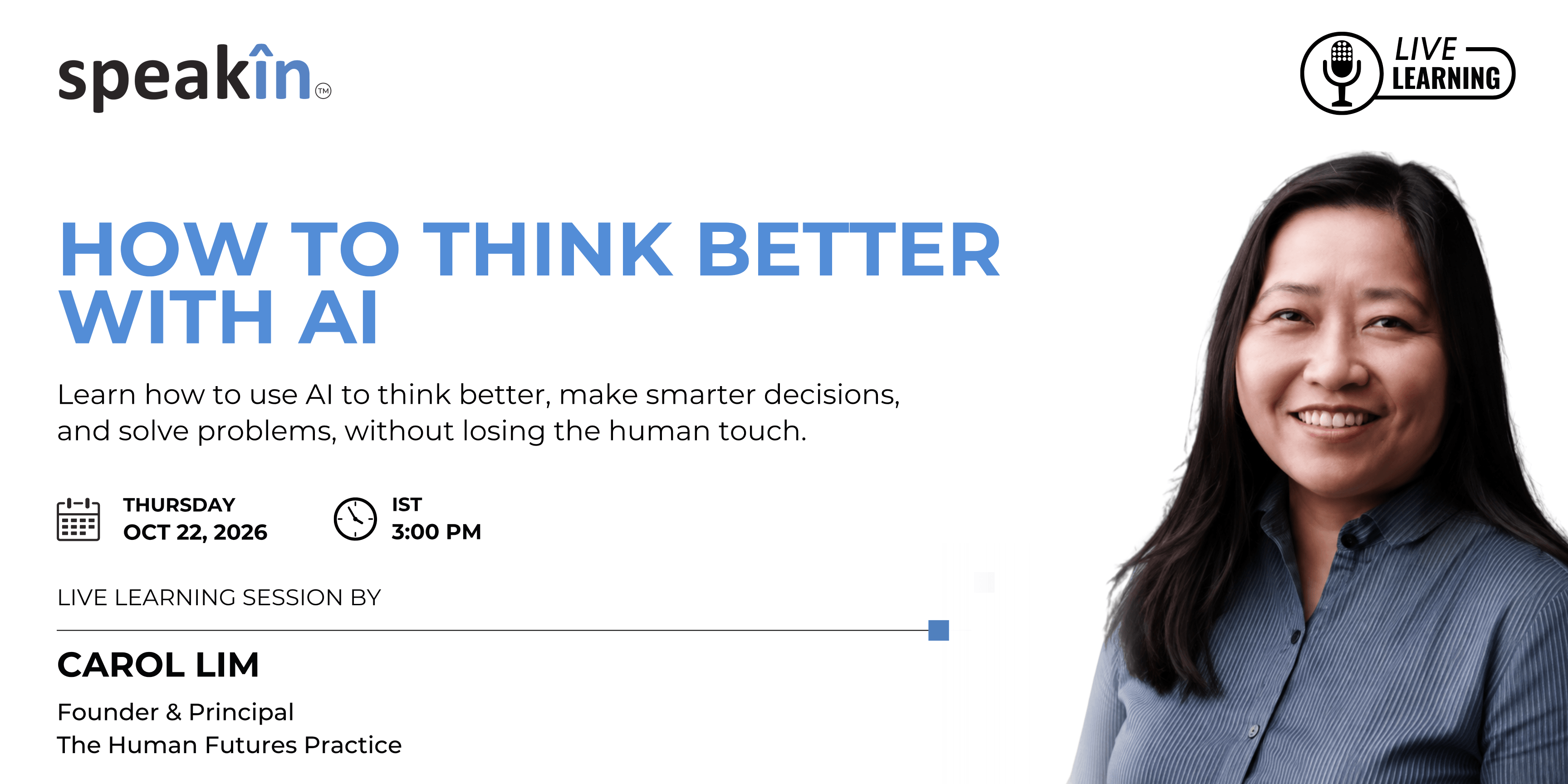
Carol Lim will show you how to use AI as a thinking partner while keeping your own judgment sharp. Using neuroscience-based tools, she will walk you through how to spot when AI is genuinely strengthening your thinking versus when it's quietly weakening your judgment. You'll learn to distinguish AI-generated intelligence from the human context, discernment, and accountability that sound decisions require, and how to apply the Human-AI-Human Loop to use AI without outsourcing judgment.
This session works whether you use AI every day or you're still deciding if you should. You do not need any technical background. You just need to be someone who makes decisions and wants to make them better.
• Recognise the split - Where AI strengthens your thinking, and where it can quietly weaken your judgment.
• Distinguish AI intelligence from human judgment - Tell apart what AI generates from the human context, discernment, and accountability sound decisions actually require.
• Apply the Human-AI-Human Loop - A practical model for using AI as a thinking partner without outsourcing the judgment call to it.
• Question AI outputs on purpose - Practical habits that surface blind spots and force more considered decisions instead of premature ones.
Carol Lim spent years as a tech startup COO before becoming an executive coach. In 25+ years across government, tech, education, and entrepreneurship, she has helped leaders make clearer decisions under pressure. She holds a degree from the University of Oxford and is based in Singapore.
She uses neuroscience-backed methods, not theory. Her work helps people think more boldly, question their own assumptions, and turn uncertainty into an advantage instead of a threat.
Her track record includes coaching a team's presentation that won the LHL IDM Smart Nation Award, and being personally credited by MENDAKI's Deputy CEO for keeping tuition running for 3,000 students through a fast pivot to online learning.
Today she runs The Human Futures Practice, helping organizations build leaders who are ready for what is next.