
Leading with Purpose: Satishchandra Doreswamy on Technology, Trust, and the Future of Leadership
With over 35 years of experience, Satishchandra Doreswamy shares his perspective on leading with purpose in an era defined by AI, cloud innovation, and rapid transformation. From building TCS’ cloud capabilities to shaping sovereign cloud strategy, he reflects on the role of trust, continuous learning, and human-centric leadership in navigating the future of business and technology.
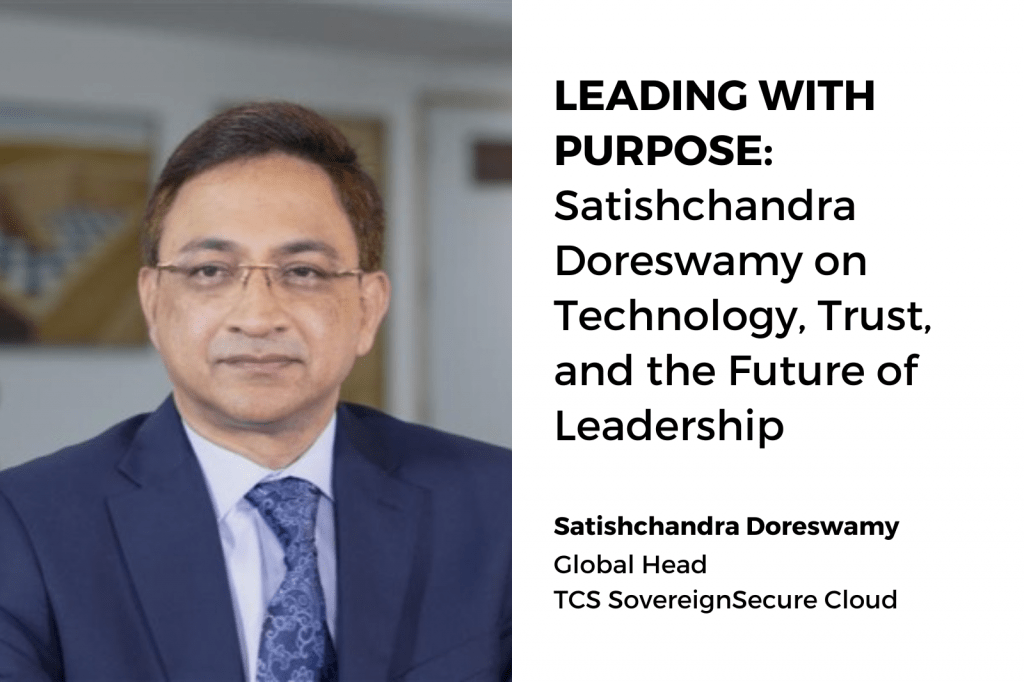
Satishchandra Doreswamy | Global Head – TCS SovereignSecure Cloud, Tata Consultancy Services
With over 35 years of experience spanning mainframe architecture, entrepreneurship, and cloud innovation, Satishchandra Doreswamy has built a career at the intersection of technology and business transformation. As Global Head of TCS SovereignSecure Cloud at Tata Consultancy Services, he now leads one of the most strategically significant mandates in enterprise technology — helping organisations navigate sovereignty, security, and the age of AI. In this conversation, Satishchandra reflects on the experiences that shaped his leadership, the forces transforming the industry, and the wisdom he would pass on to the next generation.
What defining experiences have most influenced your leadership journey?
Many instances have shaped my leadership style across roles and helped me evolve in my 35-year career. Each role came with a spectrum of opportunities, challenges, and learning that influenced my leadership journey.
I began my journey as an expert in mainframe, which was prevalent in my formative years. My passion for the technology world enabled me to excel as a Technical Architect. This role was very dynamic as it entailed frequent interactions with experts across functions like technical, domain, and strategy. I got first-hand experience of the significant role technology plays in creating exponential business value. This role empowered me to gain a bigger picture and a holistic enterprise-wide vision.
My profound liking for newness has played a key part in shaping my career to date. I was always on top of the key trends in the ever-changing technology landscape. When I founded a firm, I could build a technology solution from scratch to scale and success. I also understood the significance of having an empowered workforce in building business success. What resonated with me was not the technology itself, but how deeply it could reshape business outcomes when aligned with strategy and people.
My fondness for newness continued with TCS entrusting me with the task of building TCS’ Private Cloud business from scratch. I could elevate the value proposition with a hybrid cloud approach, which became a major differentiator for TCS in the industry. Building anything new and unique has its rewards. Currently, I am responsible for shaping our global Sovereign Cloud strategy. Our investments in the private cloud, hybrid cloud solutions, and our Sovereign Cloud are well recognised by customers and industry analysts.
How do you balance personal values with organisational priorities in decision-making?
I think every leader faces a dilemma that calls for balancing personal values with organisational priorities.
The ability to choose the optimal path without compromising personal values plays a crucial role in tackling this leadership dilemma every day. I am in a happy space where my personal values like empathy, integrity, and mentorship align well with TCS values, such as leading change, integrity, respect for the individual, empathy, and learning and sharing. This has made my decision-making much more efficient.
I believe that the culture promoted in an organisation should subscribe to a value system that reduces, if not eliminates, conflict in decision-making. As TCS associates, we are globally renowned for our value-driven quality governance derived from being true to the values enshrined in the time-tested Tata Code of Conduct. Tough calls become clearer when values like integrity and empathy act as non-negotiables, guiding decisions beyond immediate business pressures.
What key shifts do you see transforming your sector today?
The most defining shift transforming our sector today is the growing indispensability of AI. What began as an efficiency lever has now become central to how enterprises operate, compete, and innovate. Alongside this, sustainability has moved decisively from a compliance checkbox to a core operational and strategic priority.
At the same time, we are entering a pivotal moment in the technology landscape with the rise of quantum computing. While still emerging, quantum is widely viewed as a breakthrough capable of solving classes of problems that are simply beyond the reach of classical systems.
The real inflection point, however, will come from the convergence of these two forces. Quantum AI — where quantum computing is combined with intelligence — has the potential to redefine how complex decisions are made, models are trained, and insights are generated at scale.
In parallel, AI-led automation is rapidly maturing. By bringing together AI, machine learning, and robotic process automation, enterprises are moving beyond rule-based efficiency toward intelligent, self-learning agentic systems that can handle complex and unstructured workflows. The outcome is not just higher accuracy and lower costs, but fundamentally more adaptive and resilient operations.
Taken together, AI today and Quantum AI tomorrow represent a profound shift in how value will be created across industries.
Which emerging trend do you believe leaders must prepare for most urgently?
AI will increasingly become an inherent part of the business value chain. Continuous reskilling, human-AI collaboration, and leadership that understands both technology and value creation are becoming essential.
As AI becomes embedded across core functions, organisations are increasingly seeking talent that can bridge technology expertise with business context and decision-making. The focus is shifting from isolated technical skills to multi-dimensional capabilities — AI literacy, domain knowledge, and the ability to apply technology to solve real business problems.
Ultimately, enterprises that win will be those that build talent ecosystems capable of turning advanced technology into measurable business outcomes.
What advice would you give to the next generation of leaders looking to create lasting influence?
I think first and foremost, be passionate about the entire scheme of things involving technology while understanding how it can impact lives and businesses at scale.
One must perpetually adapt, evolve, and innovate while developing agility and a holistic understanding of complex projects. It is imperative to visualise how disruption can impact the business and economy at large. It is also important for a leader to proactively anticipate change and trends rather than react to them.
A good leader must develop the ability to collaborate and empathise in a synergetic setup so that others can align with the transformation vision.
Lastly, and importantly, rather than viewing challenges as obstacles, one must leverage critical thinking to transform them into opportunities.
If you could leave our readers with one powerful thought that reflects your leadership philosophy, what would it be?
Broadly speaking, one should empathetically lead change, be relentlessly purposeful and adaptable, and invest in continual learning while empowering others.
What was the most valuable insight or connection you gained from participating in ADF?
ADF offered crucial insights into cross-industry perspectives — from construction and education to manufacturing and consulting. My takeaways also include being mindful of the huge skill gap in AI-led transformation and the changing talent expectations across industries. It is imperative that we nurture and enable the bright minds of Gen Z and Gen Alpha by mentoring them. By doing so, we are addressing the talent crunch by minimising the skill gap while building potential future leaders. It was heartening to note that by 2030, there is huge potential for jobs that will be created by AI, while realising how automation and AI are reshaping skill demand.
How do you see ADF contributing to shaping future dialogues on leadership and growth across Asia?
I consider ADF as a key enabler in shaping future leadership and driving talent conversations across Asia. This forum is unique as it is a confluence of industry leaders, technologists, and educationalists, enabling a platform for understanding and nurturing future talent needs. If we collaborate with the government or education sector and share insights from ADF sessions, it can work wonders in shaping talent. This forum can play a crucial role in building technology, diverse talent, and industry connections, thereby impacting the future economy of Asia.


